
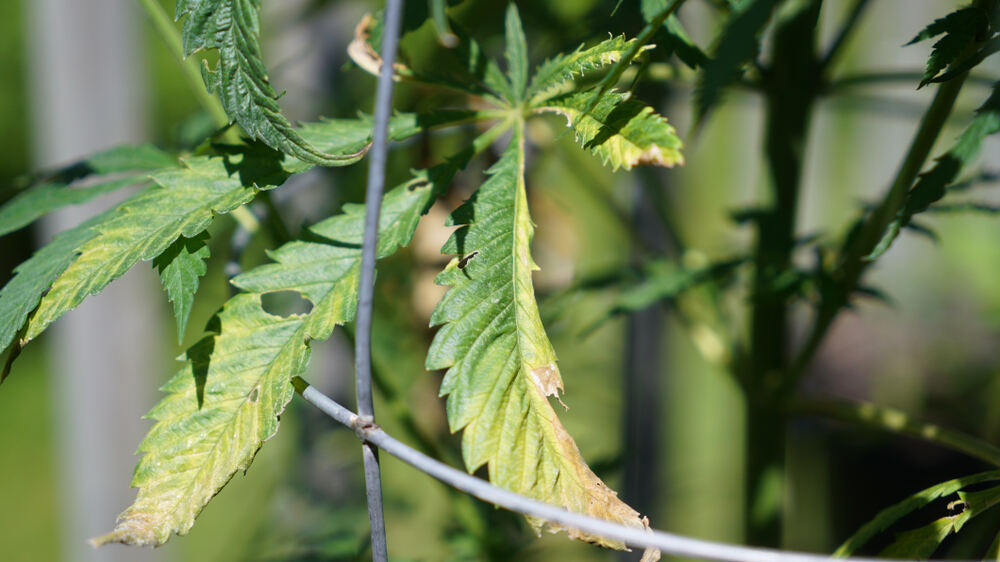
Potassium Deficiency In Autoflowers: Signs, Causes, Treatment And Prevention
Potassium deficiency is a common nutrient issue in autoflower cannabis plants, especially during flowering when demand for nutrients increases. Potassium plays a key role in water regulation, photosynthesis, nutrient transport, and bud development, so a deficiency can slow growth, reduce flower production, and impact overall yields.
One of the biggest challenges is that potassium deficiency symptoms often resemble other problems, including nutrient burn, calcium deficiency, magnesium deficiency, and nutrient lockout. Common signs include yellowing leaf edges, burnt tips, rust spots, and curling leaves. Because these symptoms develop gradually, the issue can go unnoticed until plant health begins to decline.
Early diagnosis is particularly important for autoflowers. Unlike photoperiod strains, autoflowers have a fixed lifecycle and limited time to recover from nutrient imbalances. If left untreated, potassium deficiency can affect plant size, bud density, terpene production, and harvest quality.
In this guide, you’ll learn how to identify potassium deficiency in autoflowers, understand its most common causes, and apply the correct treatment before it affects your crop. We’ll also cover potassium toxicity, nutrient lockout, recovery times, and the best potassium sources to keep your autoflowers healthy from seed to harvest.
Article Insights
- Potassium deficiency in autoflowers usually starts on older fan leaves, causing yellowing or burnt leaf edges before symptoms spread throughout the plant.
- Because autoflowers have a short, fixed lifecycle, potassium deficiencies can quickly affect growth, flower development, and final yields if left untreated.
- Potassium is essential for water regulation, nutrient transport, photosynthesis, and healthy bud formation during every stage of growth.
- The risk of potassium deficiency increases during flowering, when autoflowers require higher nutrient levels to support bud development and resin production.
- Maintaining proper pH, avoiding overwatering, monitoring runoff EC, and preventing salt buildup are key to avoiding both potassium deficiency and potassium toxicity.
Why Potassium Is Essential For Healthy Autoflower Growth
Potassium is one of the three primary macronutrients autoflower cannabis plants require throughout their entire lifecycle, alongside nitrogen and phosphorus. While nitrogen primarily supports leafy vegetative growth and phosphorus drives root development and flowering, potassium plays a vital role in regulating many of the biological processes that allow autoflowers to grow quickly and produce healthy yields.
I often describe potassium as the “traffic controller” of autoflower growth because it helps manage the movement of water, sugars, nutrients, and energy throughout the plant. Without sufficient potassium, autoflower cannabis plants struggle to maintain vigorous growth, strong stems, efficient photosynthesis, and productive flower development.
One of potassium’s most important functions is regulating stomata activity. Stomata are microscopic pores found on the underside of cannabis leaves that control gas exchange and transpiration. When potassium levels are adequate, autoflowers can efficiently absorb carbon dioxide for photosynthesis while regulating water loss. If potassium availability drops, water movement and nutrient transport become less efficient, often leading to slower growth and increased susceptibility to environmental stress.
Potassium also supports several essential processes within autoflower cannabis plants:
| Potassium Function | Benefit For Autoflower Cannabis Plants |
| Protein synthesis | Supports healthy growth and tissue development |
| Carbohydrate transport | Moves sugars to developing buds and growing tissues |
| Enzyme activation | Helps regulate essential metabolic processes |
| Root development | Encourages stronger root systems and nutrient uptake |
| Water uptake | Improves hydration and nutrient movement |
| Stress resistance | Helps plants cope with heat, drought, and environmental fluctuations |
Because potassium influences so many systems simultaneously, potassium deficiency in autoflowers often produces multiple symptoms at once. Growers may notice weak growth, burnt leaf edges, poor flower development, reduced vigour, and lower resistance to heat, drought, or other environmental stresses.
During the vegetative stage, autoflower cannabis plants rely on potassium to support rapid cell expansion, branch development, and stem strength. Healthy potassium levels help produce thicker stalks, stronger side branches, and more vigorous growth before the plant transitions into flowering.
Potassium Requirements Throughout The Autoflower Lifecycle
| Growth Stage | Potassium Importance | Impact Of Deficiency |
| Seedling | Low to moderate | Slow establishment and weak early growth |
| Vegetative Stage | Moderate to high | Reduced growth rate, weaker stems, smaller plant size |
| Pre-Flower | High | Poor transition into flowering and reduced bud site development |
| Flowering Stage | Very high | Airy buds, reduced resin production, lower yields |
| Late Flowering | High | Slower bud swelling and reduced flower quality |
This is especially important because autoflowers have a fixed lifecycle. Unlike photoperiod strains, autoflowers automatically enter the flowering stage after only a few weeks of vegetative growth. With such a short window for recovery, nutrient deficiencies can have a greater impact on final plant size, bud production, and overall yield. Even a mild potassium deficiency during early growth can reduce the plant’s ability to reach its full genetic potential.
As flowering begins, potassium demand increases significantly. Developing buds require large amounts of water, carbohydrates, and nutrient movement throughout the plant, and potassium plays a direct role in transporting these resources to flower sites. This is why potassium deficiency in autoflowers commonly appears during mid-flowering, when plants are directing most of their energy towards bud development and resin production.
If potassium levels become insufficient during bloom, autoflower growers may notice:
| Symptom | Effect On Harvest |
| Airy or underdeveloped buds | Reduced bud density and lower yields |
| Reduced trichome production | Lower resin content and potency |
| Weaker terpene profiles | Less aroma and flavour |
| Slower flower development | Delayed bud maturation |
| Increased susceptibility to heat stress | Greater risk of environmental damage |
| Lower overall yields | Reduced harvest weight and quality |
Because autoflowers flower so quickly, these effects can become noticeable in a short period of time. Delayed corrections often result in permanent reductions in bud quality and harvest weight.
Potassium also explains why cannabis leaf potassium deficiency symptoms typically appear on older fan leaves first. Potassium is a mobile nutrient, meaning the plant can move stored reserves from older leaves to support newer growth and developing flowers when supplies become limited. As a result, lower leaves often show the earliest warning signs of a deficiency.
Why Potassium Deficiency Appears On Older Leaves First
| Nutrient Characteristic | What It Means |
| Potassium is mobile | The plant can relocate potassium where it is needed most |
| Older leaves act as reserves | Stored potassium is pulled from mature leaves |
| New growth is prioritised | Young leaves and flowers receive available nutrients first |
| Early symptoms appear low on the plant | Yellowing and burnt leaf edges often start on older fan leaves |
Maintaining balanced potassium levels throughout the entire autoflower lifecycle is one of the most important factors in producing healthy, high-yielding plants. Consistent potassium availability supports strong growth, efficient nutrient uptake, dense bud formation, resin production, and overall performance from high yield autoflower seeds.
Key Benefits Of Adequate Potassium In Autoflowers
| Benefit | Result |
| Stronger stems and branches | Better support for heavy buds |
| Improved water regulation | Reduced stress during hot conditions |
| Enhanced nutrient transport | More efficient growth and flowering |
| Better bud development | Denser flowers and improved yields |
| Increased resin production | Higher trichome output |
| Greater stress tolerance | Improved resilience throughout the lifecycle |
If you are unsure whether your autoflowers are suffering from potassium issues or another nutrient imbalance, check out our full cannabis nutrient deficiency guide.
Symptoms Of Potassium Deficiency In Cannabis Plants
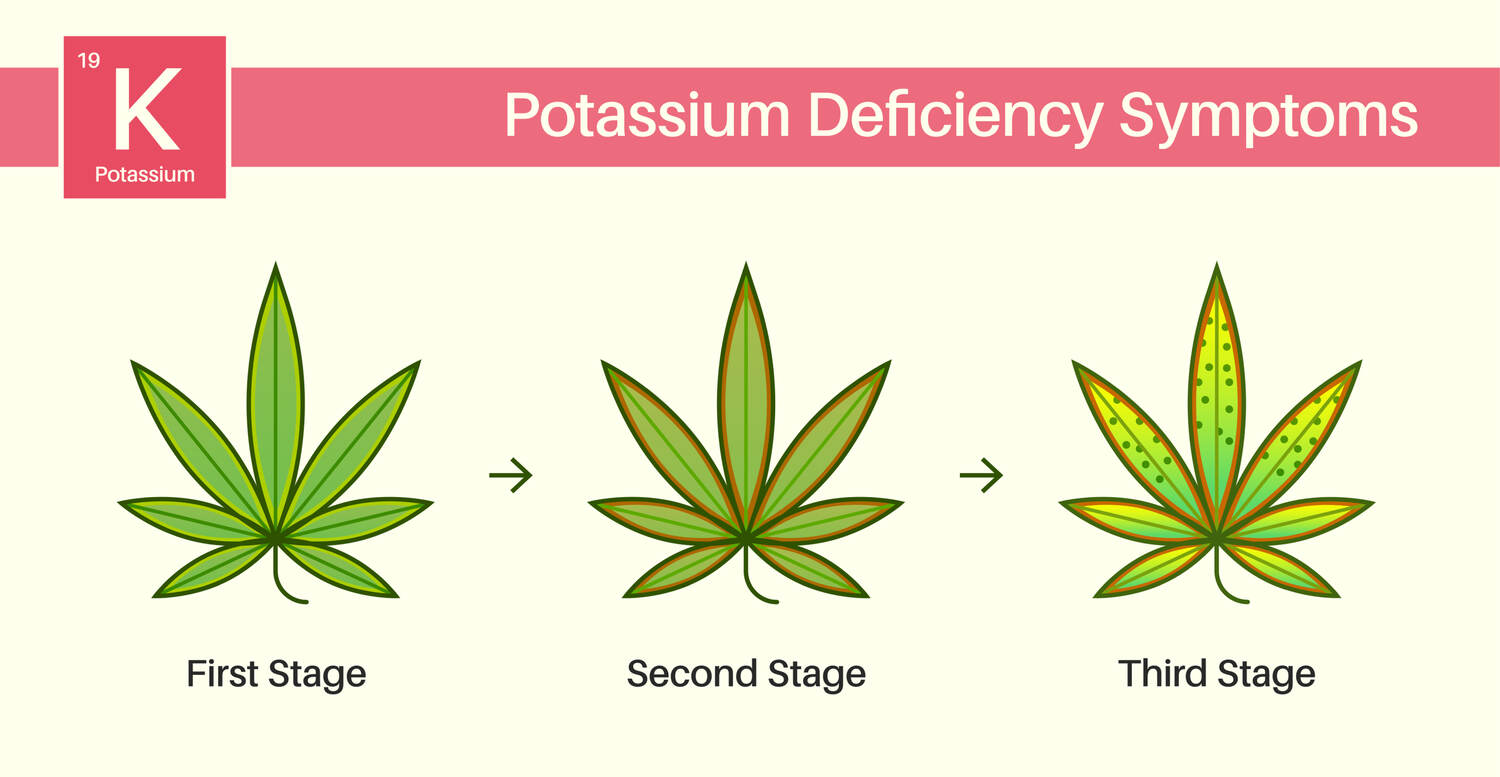
Potassium deficiency in autoflower cannabis plants usually begins subtly before progressing into severe leaf damage, reduced flower production, and lower yields. One of the biggest mistakes growers make is waiting too long before taking corrective action. By the time leaves become heavily burnt, curled, and crispy, the deficiency has often been developing inside the plant for several days or even weeks.
Because potassium is a mobile nutrient, autoflower cannabis plants pull stored potassium from older fan leaves and redirect it towards newer growth and developing flowers. This means symptoms almost always begin on the lower leaves before gradually spreading upwards through the canopy.
For autoflower growers, early detection is particularly important. Unlike photoperiod strains, autoflowers have a fixed lifecycle and cannot remain in the vegetative stage while recovering from nutrient problems. Even a mild potassium deficiency can reduce plant size, bud development, resin production, and final harvest weight if left untreated for too long.
The good news is that potassium deficiency symptoms in autoflowers usually follow a predictable progression. Knowing what to look for allows growers to identify the problem early and correct it before it significantly affects yield or flower quality.
Common Symptoms Of Potassium Deficiency In Autoflowers
| Symptom | What You’ll See | Why It Happens | Impact On Autoflowers |
| Yellow leaf edges | Yellowing begins around serrated leaf margins while the centre stays greener | Potassium is pulled from older leaves to support new growth | Slower vegetative growth and reduced plant size before flowering |
| Pale leaf margins | Leaf edges appear faded or washed out | Reduced chlorophyll production and nutrient movement | Less vigorous growth and weaker overall development |
| Brown leaf tips | Tips become bronze or burnt-looking | Leaf tips receive nutrients last | Reduced photosynthetic efficiency and slower growth |
| Reduced growth vigour | Slower growth, weaker branching, smaller leaves | Potassium supports energy transfer and protein synthesis | Smaller plants with fewer bud sites |
| Dull leaf colour | Leaves lose their healthy green appearance | Reduced photosynthesis and chlorophyll activity | Lower energy production during critical growth stages |
| Burnt crispy edges | Leaf margins become dry, brittle, and crunchy | Poor water regulation causes tissue dehydration | Increased stress and reduced flower production |
| Rust spots | Brown or rust-coloured spots form on leaves | Cellular breakdown caused by nutrient stress | Reduced nutrient uptake and bud development |
| Leaf curling | Leaves curl upwards or inwards | Loss of moisture control and turgor pressure | Lower photosynthetic efficiency during flowering |
| Necrosis | Dead brown tissue spreads across leaves | Plant cells die from prolonged deficiency | Permanent tissue damage that cannot be reversed |
| Weak stems | Branches become thin or brittle | Potassium supports structural strength | Difficulty supporting heavy autoflower buds |
| Poor flower development | Buds remain airy with reduced resin and terpene production | Flowering plants require high potassium levels | Lower yields, reduced potency, and weaker aromas |
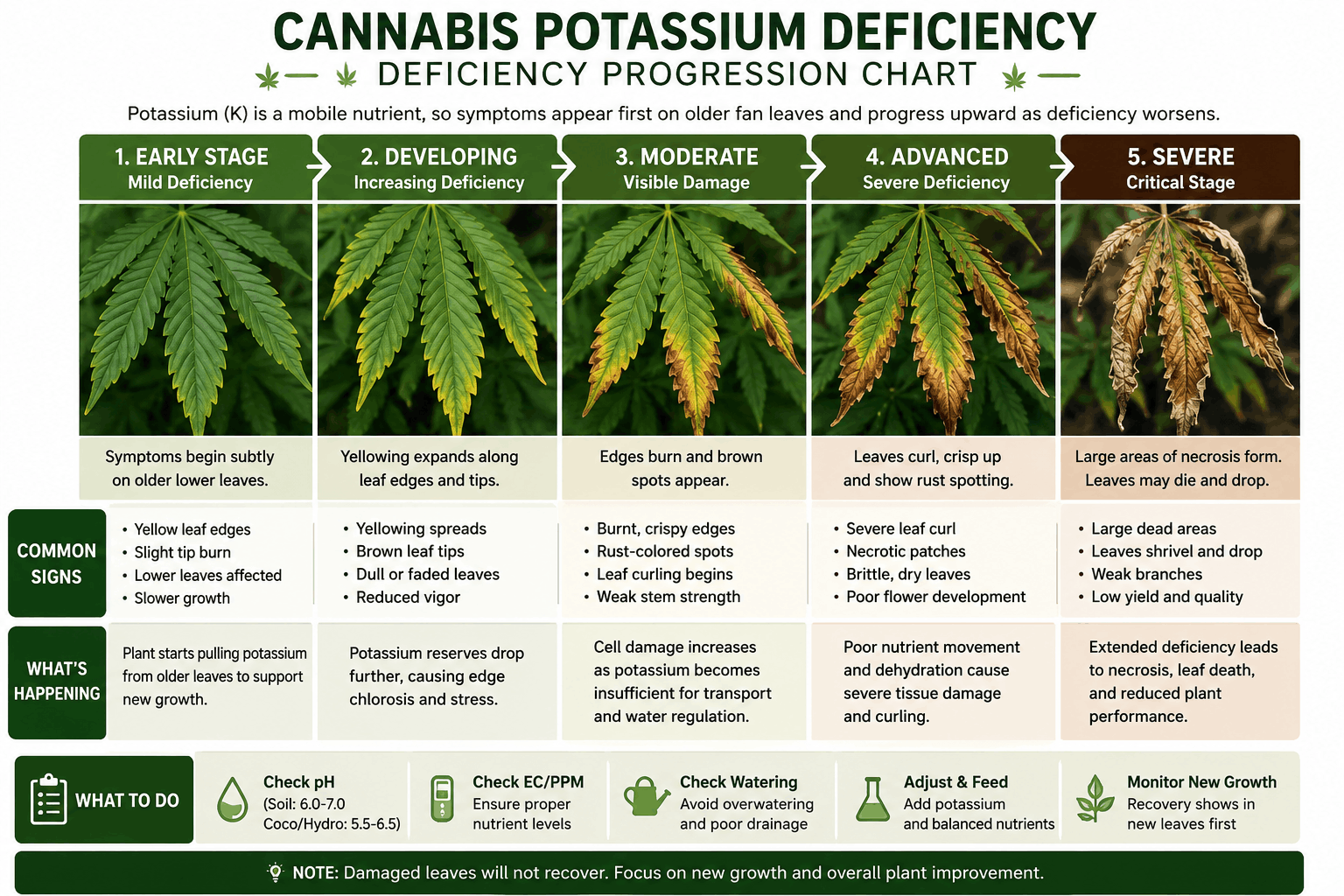
Early Signs Of Potassium Deficiency In Autoflowers
Early-stage potassium deficiency often develops slowly enough that growers overlook it entirely. Early-stage potassium deficiency can be easy to miss. Plants often appear healthy overall while subtle symptoms develop on older leaves near the bottom of the canopy.
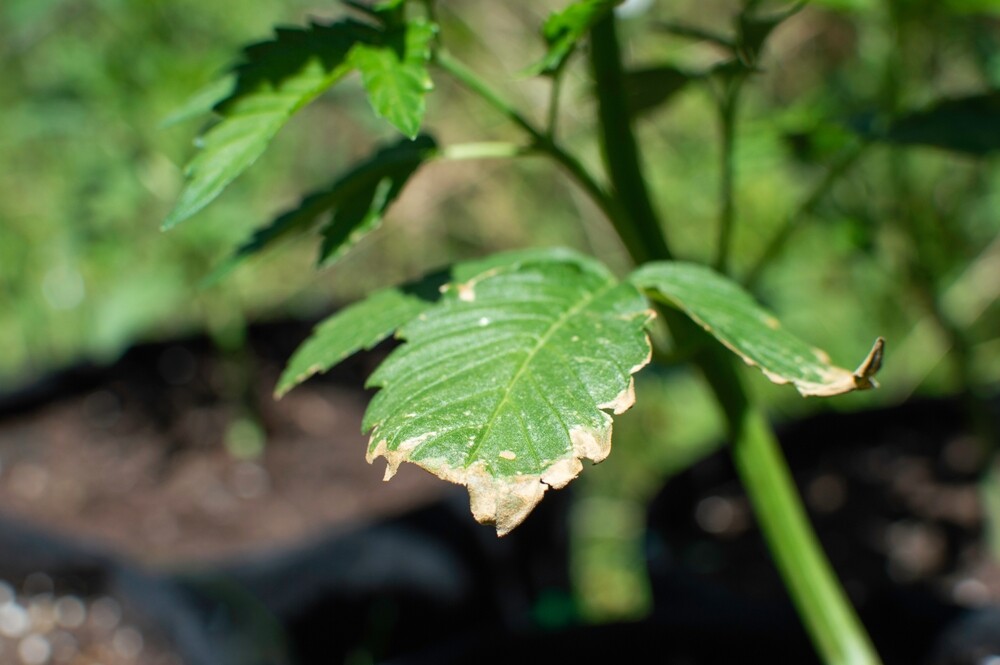
One of the first signs is yellowing around the leaf edges. Unlike nitrogen deficiency, which causes more uniform yellowing, potassium deficiency affects the margins first. The serrated edges gradually fade from green to yellow before turning brown.
Leaf tips may also develop a bronze or burnt appearance. This occurs because potassium plays a key role in water regulation and nutrient transport. When uptake becomes restricted, the outermost parts of the leaf are affected first.
Other common early symptoms include:
- Slower vertical growth
- Reduced branch development
- Smaller fan leaves
- Less vigorous stretching during pre-flower
- Dull foliage
- Reduced water consumption
Many growers notice a general loss of vigour before severe leaf damage appears. Plants simply stop growing as quickly as healthy autoflowers.
Reduced water uptake is another overlooked symptom. Since potassium helps regulate stomata function, deficient plants often drink less water and may appear slightly droopy even when the growing medium remains moist.
Because autoflowers have a short vegetative stage, correcting deficiencies early is essential. Problems that develop during weeks 2 to 4 can affect growth and yield for the remainder of the plant’s lifecycle.
Advanced Potassium Deficiency Symptoms In Autoflowers
As the deficiency worsens, symptoms become much more obvious. Water regulation, nutrient transport, and other key plant functions begin to break down, leading to widespread damage.
One of the most recognisable signs is burnt, crispy leaf edges. The margins turn dark brown, dry, and brittle before gradually spreading inward. In severe cases, affected tissue may crumble when touched.
Rust-coloured spots often appear on older leaves as cells begin to die from prolonged nutrient stress. These symptoms are sometimes confused with calcium deficiency, but potassium deficiency typically starts on older leaves due to its mobility within the plant.
Leaf curling also becomes more pronounced. Edges may curl upwards or inwards while developing a dry texture as the plant struggles to maintain proper moisture balance.
As the deficiency progresses further, necrosis develops across larger sections of the leaves. Once tissue becomes necrotic, it cannot recover even after potassium levels are restored.
Severely deficient autoflowers may also develop weak stems and branches that struggle to support flower weight. Because autoflowers continue flowering regardless of nutrient status, advanced deficiencies often result in permanently reduced yields and lower-quality buds.
Potassium Deficiency During The Autoflower Flowering Stage
Potassium demand increases significantly once autoflowers enter flowering, which is why deficiencies commonly appear during weeks 4 to 8.
Potassium Demand Throughout The Autoflower Lifecycle
| Growth Stage | Potassium Demand |
| Seedling | Low |
| Early Vegetative Growth | Moderate |
| Late Vegetative Growth | Moderate-High |
| Pre-Flower Transition | High |
| Peak Flowering | Very High |
| Late Flowering | High |
During flowering, potassium supports:
- Bud swelling
- Resin production
- Terpene development
- Water regulation
- Carbohydrate transport
- Nutrient movement throughout the plant
When potassium levels become insufficient during bloom, growers may notice:
- Loose or airy buds
- Reduced trichome production
- Weaker aroma and flavour
- Burnt sugar leaves
- Slower flower development
- Reduced bud density
- Lower yields
Autoflowers are particularly vulnerable during flowering because there is little time to recover from nutrient problems. A deficiency during peak bloom can quickly reduce bud size, resin production, and terpene content.
Regularly monitoring pH, EC, and runoff is especially important in coco and hydroponic systems, where nutrient imbalances can develop rapidly. Maintaining adequate potassium levels throughout flowering is one of the most effective ways to maximise bud density, potency, and overall performance from high THC autoflower strains.
How To Tell Potassium Deficiency Apart From Nutrient Burn Or Calcium Deficiency
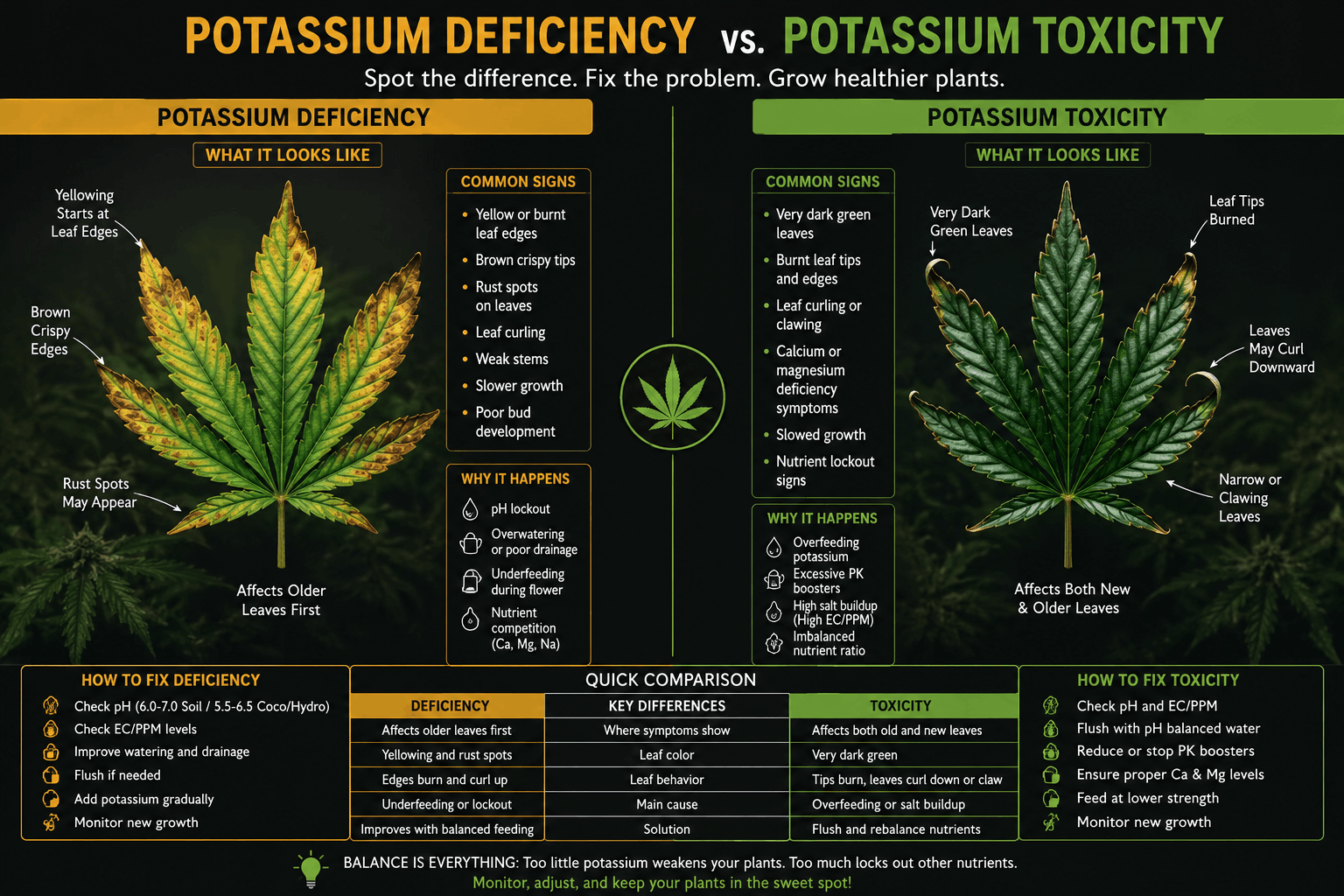
Potassium deficiency, calcium deficiency, and nutrient burn can all produce damaged-looking leaves, but there are important differences.
| Problem | Starts Where | Main Symptoms | Common Cause |
| Potassium deficiency | Older leaves | Burnt edges, curling | Lockout or underfeeding |
| Calcium deficiency | New growth | Rust spots, twisted leaves | Calcium uptake issue |
| Nutrient burn | Leaf tips | Dark green clawing | Overfeeding |
I always look at where symptoms begin on the plant because nutrient mobility tells you a lot about the underlying issue.
What Causes Potassium Deficiency In Autoflower Cannabis Plants
Potassium deficiency in autoflower cannabis plants is not always caused by a lack of potassium in your nutrient solution. In many cases, potassium is present in the growing medium, but the roots cannot absorb it properly. This is why adding more nutrients does not always fix the problem and can sometimes make it worse.
When diagnosing potassium deficiency, it is important to consider the entire growing environment. Issues such as incorrect pH, overwatering, nutrient competition, restricted root growth, and salt buildup are often the real cause.
Because autoflowers have a short lifecycle, identifying and correcting the underlying issue quickly is essential. Delays can reduce growth, flower development, and final yields.
Incorrect pH And Potassium Lockout
Improper pH is one of the most common causes of potassium deficiency. Even when potassium is available, roots cannot absorb it efficiently if the root zone falls outside the ideal range.
| Growing Medium | Recommended pH Range |
| Soil | 6.0–7.0 |
| Coco Coir | 5.8–6.3 |
| Hydroponics | 5.5–6.5 |
When pH drifts too high or too low, nutrient lockout can occur, making potassium unavailable to the plant. This is particularly common in coco and hydro systems where pH can fluctuate rapidly.
Before increasing nutrient strength, always check pH levels. In many cases, correcting the pH restores potassium uptake without additional feeding.
Overwatering And Poor Root Health
Healthy roots need oxygen as well as water. When the growing medium stays saturated for too long, oxygen levels drop and nutrient uptake slows.
Poor drainage and overwatering can lead to:
- Root stress
- Reduced oxygen availability
- Weak transpiration
- Reduced potassium absorption
Autoflowers are especially sensitive to root problems because they have limited time to recover. If pots remain wet longer than usual and deficiency symptoms appear, poor root zone conditions may be contributing to the issue.
Underfeeding During Flowering
Potassium demand increases significantly once autoflowers enter the flowering stage. The nutrient plays a key role in bud development, resin production, carbohydrate transport, and water regulation.
Deficiencies commonly appear during mid-flowering when nutrient demand peaks. Symptoms may include:
- Burnt leaf edges
- Airy buds
- Reduced trichome production
- Slower flower development
Using a balanced bloom nutrient and adjusting feeding levels as flowering progresses can help prevent deficiencies during this critical stage.
Nutrient Competition
Potassium uptake can also be reduced when other nutrients are present in excessive amounts. High levels of calcium, magnesium, sodium, or ammonium nitrogen may compete with potassium for absorption.
This issue is often seen in:
- Hard water grows
- Coco coir systems
- Overfed hydroponic setups
- Media with salt buildup
In these situations, potassium may be present but unavailable due to nutrient imbalance. Monitoring runoff EC and avoiding excessive feeding can help maintain proper nutrient ratios.
Restricted Roots And Salt Buildup
Autoflowers grow quickly and perform best when roots have plenty of space to develop. Small containers can restrict root growth, reducing nutrient uptake and increasing the risk of deficiencies during flowering.
Salt buildup is another common issue, particularly in coco and hydro systems. Excess salts can interfere with nutrient availability and trigger potassium lockout.
Signs of salt accumulation include:
- Rising runoff EC
- Burnt leaf tips
- Multiple deficiency symptoms
- Reduced plant vigour
Regular monitoring of pH and EC helps prevent these problems before they affect growth.
In most cases, potassium deficiency in autoflowers is caused by poor nutrient availability rather than a lack of potassium itself. Maintaining proper pH, healthy roots, balanced feeding, and good growing conditions will help ensure consistent potassium uptake throughout the plant’s lifecycle.
How To Treat Potassium Deficiency In Autoflower Cannabis Plants
Once you identify potassium deficiency in an autoflower, correct the underlying cause before adding more nutrients. Burnt leaf edges often tempt growers to increase bloom feed, but the real issue may be pH lockout, salt buildup, overwatering, or poor root health.
Because autoflowers have a short lifecycle, acting quickly is important to minimise any impact on growth and flower development.
Potassium Deficiency Treatment Checklist
| Step | What To Do | Why It Matters |
| 1 | Check pH | Ensures potassium is available to the roots |
| 2 | Check EC or PPM | Identifies underfeeding or nutrient buildup |
| 3 | Inspect roots and watering | Rules out root stress and overwatering |
| 4 | Flush if runoff EC is high | Removes excess salts causing lockout |
| 5 | Increase potassium gradually | Corrects the deficiency safely |
| 6 | Monitor new growth | Confirms recovery |
Step 1: Check pH First
Start by testing the pH of your feed and runoff.
| Growing Medium | Recommended pH |
| Soil | 6.0–7.0 |
| Coco Coir | 5.8–6.3 |
| Hydroponics | 5.5–6.5 |
If pH falls outside these ranges, potassium may be present but unavailable to the plant. Correct pH before increasing nutrient strength, as adding more nutrients to a locked-out root zone can worsen the problem.
Step 2: Check EC Or PPM
Measure EC or PPM to determine whether the plant is underfed or dealing with excess nutrient buildup.
High runoff EC often indicates:
- Salt buildup
- Overfeeding
- Nutrient lockout
This is particularly useful in coco and hydro systems, where nutrient levels can change quickly.
Step 3: Inspect Root Health And Watering
Overwatering can severely reduce potassium uptake by limiting oxygen around the roots.
Look for:
- Pots staying wet too long
- Slow dry-back times
- Drooping leaves
- Sour smells
- Brown or slimy roots in hydro
Healthy roots should be white and vigorous. If the medium remains saturated, improve drainage and adjust watering before increasing nutrients.
Step 4: Flush If Runoff EC Is High
If runoff EC is significantly higher than your input solution, excess salts may be causing nutrient lockout.
Flush with pH-balanced water until runoff EC begins to drop, then reintroduce nutrients gradually. Avoid returning immediately to full-strength feeding.
Step 5: Increase Potassium Gradually
Once pH, EC, and root health are corrected, increase potassium carefully.
| Potassium Source | Best Use |
| Potassium sulfate | Fast correction |
| Balanced bloom nutrients | Flowering support |
| PK boosters | Flowering supplementation |
| Kelp meal | Organic growing |
| Greensand | Slow-release organic amendment |
Avoid large increases in nutrient strength. Excess potassium can interfere with calcium and magnesium uptake, creating additional deficiencies.
Step 6: Monitor New Growth And Flower Development
Damaged leaves rarely recover, so focus on new growth rather than old symptoms.
Signs of recovery include:
- Healthier new leaves
- Improved growth
- Increased water uptake
- Better bud development
- Symptoms no longer spreading
Mild deficiencies may improve within 3–7 days, while more severe cases can take 1–3 weeks to stabilise.
Can Autoflowers Recover From Potassium Deficiency?
Yes, most autoflowers recover well from mild to moderate potassium deficiencies when treated early.
Severe deficiencies during flowering can permanently reduce:
- Bud size
- Resin production
- Terpene development
- Yield
The sooner the issue is identified and corrected, the better the chances of maintaining flower quality and harvest weight.
The Best Potassium Sources And Fertilisers For Autoflower Cannabis Plants
The best potassium source for autoflowers depends on your growing medium and feeding style. Fast-acting supplements are ideal for correcting deficiencies during flowering, while slow-release amendments suit organic and living soil grows.
Best Potassium Sources For Autoflowers
| Potassium Source | Best For | Notes |
| Potassium Sulfate | Fast deficiency correction | Suitable for soil, coco, and hydro |
| Liquid Bloom Nutrients | General feeding | Balanced source of potassium and bloom nutrients |
| PK Boosters | Mid-to-late flowering | Effective but easy to overuse |
| Kelp Meal | Organic soil | Slow-release with trace minerals |
| Greensand | Living soil | Long-term potassium amendment |
| Wood Ash | Outdoor and organic growing | High in potassium but can raise pH |
For most growers, a quality bloom nutrient or potassium sulfate is the simplest way to correct a deficiency. Organic growers may prefer kelp meal or greensand, although these work more slowly.
Choosing The Right Potassium Source
| Growing Style | Recommended Potassium Source |
| Soil | Bloom nutrients, potassium sulfate, kelp meal |
| Coco Coir | Potassium sulfate, bloom nutrients |
| Hydroponics | Potassium sulfate, bloom nutrients |
| Living Soil | Kelp meal, greensand |
| Organic Outdoor Growing | Kelp meal, greensand, wood ash |
Avoid increasing potassium too aggressively. Excess potassium can interfere with calcium and magnesium uptake, creating further nutrient imbalances.
Flushing, pH Correction, And Feeding Adjustments
If nutrient lockout is causing the deficiency, correct the root zone before adding more nutrients.
Flushing can help remove excess salts and restore nutrient uptake when runoff EC is high.
Recommended Flushing pH
| Growing Medium | Flushing pH |
| Soil | 6.2–6.5 |
| Coco Coir | 5.8–6.0 |
| Hydroponics | 5.8–6.0 |
After flushing:
- Allow roots to recover
- Reintroduce nutrients gradually
- Monitor pH and EC
- Avoid returning immediately to full-strength feeds
Gradual adjustments are usually more effective than aggressive feeding, especially with autoflowers.
How Long Do Autoflowers Take To Recover From Potassium Deficiency?
Recovery depends on the severity of the deficiency and how quickly the underlying cause is fixed.
Typical Recovery Timeline
| Severity | Expected Recovery Time |
| Mild Deficiency | 3–7 days |
| Moderate Deficiency | 1–2 weeks |
| Severe Deficiency | 2–3 weeks or longer |
Damaged leaves rarely recover fully, so focus on new growth rather than old symptoms.
Signs Your Autoflowers Are Recovering
- Richer green foliage
- Improved water uptake
- Stronger growth
- Better bud swelling
- Healthier sugar leaves
- Symptoms no longer spreading
The sooner potassium deficiency is corrected, the less impact it will have on flower development, resin production, and final yields.
Potassium Toxicity In Autoflower Cannabis Plants And How To Prevent It
When correcting potassium deficiency in autoflowers, it is important to avoid making large feeding adjustments too quickly. I always recommend making one change at a time and giving the plant several days to respond before increasing nutrient levels again. Autoflower cannabis plants need time to stabilise once root zone conditions improve.
Potassium toxicity occurs when autoflowers receive more potassium than they can effectively use. This problem most commonly develops during flowering when growers overuse PK boosters, bloom additives, or potassium-heavy nutrient supplements in an attempt to increase bud size and yields.
While the goal is usually to improve flower production, excessive potassium often creates nutrient imbalances that slow growth, reduce nutrient uptake, and negatively affect plant health.
Because autoflowers have a relatively short flowering period, nutrient mistakes made during bloom can impact bud development quickly.
What Causes Potassium Toxicity In Autoflowers?
Potassium toxicity is most commonly caused by:
- Overusing PK boosters
- Feeding bloom nutrients at excessive strength
- Stacking multiple flowering additives
- Ignoring high runoff EC levels
- Continuously increasing nutrient strength without monitoring plant response
This issue is particularly common in coco coir and hydroponic systems where nutrient concentrations can build up rapidly around the root zone.
Many growers assume more potassium automatically produces larger buds, but cannabis plants perform best when nutrients remain balanced.
Symptoms Of Potassium Toxicity In Autoflowers
Potassium toxicity is often difficult to diagnose because it frequently creates symptoms that resemble several different deficiencies and other forms of nutrient toxicity.
The most common symptoms include:
| Symptom | Why It Happens |
| Very dark green leaves | Excess nutrient accumulation |
| Burnt leaf edges | Nutrient imbalance affecting leaf tissue |
| Curling fan leaves | Root zone stress and nutrient disruption |
| Narrow or twisted leaves | Reduced nutrient balance |
| Slowed growth | Nutrient uptake becomes restricted |
| Weak stems | Secondary calcium deficiency effects |
| Rust spots | Calcium and magnesium uptake problems |
| Interveinal yellowing | Magnesium lockout symptoms |
| Multiple deficiency symptoms | Nutrient competition within the root zone |
One of the clearest warning signs is dark, glossy foliage that develops shortly after increasing bloom nutrients or PK boosters.
If plants appeared healthy before a feed increase and multiple deficiency symptoms suddenly appear, excess potassium may be contributing to the problem.
Why Excess Potassium Blocks Calcium And Magnesium
One of the biggest problems with potassium toxicity is that it rarely affects potassium alone.
Cannabis roots can only absorb a limited number of nutrient ions at any given time. When potassium levels become excessive, it competes directly with calcium and magnesium for uptake.
This means calcium and magnesium may still be present in the nutrient solution but unavailable to the plant.
As a result, autoflowers often begin showing secondary symptoms such as:
- Rust spots
- Weak stems
- Leaf curling
- Interveinal chlorosis
- Slower flower development
Many growers mistakenly respond by adding more Cal-Mag supplements. However, if excess potassium is the underlying issue, adding more nutrients can worsen the imbalance rather than solve it.
This is one reason nutrient diagnostics should always focus on the root cause rather than individual symptoms.
How To Prevent Potassium Toxicity In Autoflowers
The best way to prevent potassium toxicity is to maintain balanced feeding practices throughout the grow.
More potassium does not automatically produce bigger buds. Healthy flowering depends on stable pH, balanced nutrient ratios, proper root oxygen levels, and sensible EC levels.
Potassium Toxicity Prevention Checklist
| Prevention Strategy | Why It Matters |
| Use PK boosters according to manufacturer recommendations | Reduces risk of overfeeding |
| Increase bloom nutrients gradually | Allows plants to adjust safely |
| Monitor runoff EC regularly | Detects nutrient accumulation early |
| Check pH several times per week | Prevents nutrient lockout |
| Avoid stacking multiple bloom additives | Prevents excessive potassium levels |
| Maintain balanced calcium and magnesium levels | Supports nutrient harmony |
| Flush when runoff EC becomes excessively high | Helps remove accumulated salts |
| Watch for dark glossy foliage after feeding | Early warning sign of excess nutrients |
For autoflower growers, gradual adjustments are almost always safer than aggressive feeding increases. Because autoflowers progress through flowering quickly, there is little time to recover from nutrient imbalances once they become severe.
Can Autoflowers Recover From Potassium Toxicity?
In most cases, yes.
Mild potassium toxicity can often be corrected by reducing nutrient strength, restoring proper pH, and flushing excess salts when necessary.
Recovery usually depends on:
- How early the problem is identified
- The severity of the nutrient imbalance
- Root zone health
- The plant’s stage of development
Plants that experience mild toxicity early in flowering often recover with minimal impact. However, severe potassium toxicity during peak bloom can reduce bud density, terpene production, resin development, and final yields.
The safest approach is always prevention. Consistent feeding, regular pH and EC monitoring, and avoiding excessive use of PK boosters will help keep autoflower cannabis plants healthy while supporting strong flower development throughout the entire lifecycle.
Frequently Asked Questions About Potassium Deficiency In Autoflowers
Can Autoflowers Recover From Potassium Deficiency?
Yes, most autoflowers can recover from mild to moderate potassium deficiencies if the issue is identified and corrected early. However, severe deficiencies during flowering can permanently reduce bud size, resin production, terpene content, and overall yield. Because autoflowers have a fixed lifecycle, early intervention is especially important.
What Are The First Signs Of Potassium Deficiency In Autoflowers?
The earliest signs usually appear on older fan leaves and include yellowing around the leaf edges, pale leaf margins, burnt leaf tips, reduced growth vigour, and dull foliage. As the deficiency progresses, leaves may develop brown edges, rust spots, and curling.
Why Does Potassium Deficiency Often Appear During Flowering?
Potassium demand increases significantly once autoflowers enter the flowering stage. The nutrient is heavily involved in bud development, water regulation, carbohydrate transport, terpene production, and resin formation. Deficiencies commonly appear during mid-flowering when nutrient demand is at its highest.
What Is The Fastest Way To Correct Potassium Deficiency In Autoflowers?
Before adding more nutrients, check pH, EC, and root zone health to ensure potassium is actually available to the plant. Once any lockout issues have been corrected, potassium sulfate or a balanced bloom nutrient is usually the fastest way to restore potassium levels and support healthy flower development.
Can Overwatering Cause Potassium Deficiency?
Yes. Overwatering reduces oxygen levels around the roots, which can limit nutrient uptake even when potassium is present in the growing medium. Autoflowers are particularly sensitive to root stress, making proper watering practices essential for preventing nutrient deficiencies.
Can Too Much Potassium Harm Autoflowers?
Yes. Excess potassium can interfere with calcium and magnesium uptake, leading to secondary deficiencies, nutrient lockout, and reduced plant performance. Symptoms of potassium toxicity may include dark green leaves, burnt edges, rust spots, curling foliage, and slowed growth. Maintaining balanced nutrient levels is always more effective than aggressively increasing potassium during flowering.


